
By Jason Mills
America is increasingly discovering something our founders understood from the beginning: people who live under the same flag do not necessarily want to live under the same government. That’s not a failure of the American system. In fact, it’s one of the reasons the founders created a federal system in the first place. They understood that a large and diverse nation would contain communities with different interests, economies, cultures, and political convictions. Rather than attempting to eliminate those differences, the Constitution created a structure in which different communities could retain substantial authority over their own affairs while remaining part of a larger Union.
That principle deserves renewed consideration in an increasingly polarized America.
Today, political and cultural divisions are becoming increasingly geographic. Portland is not eastern Oregon. Seattle is not rural Washington. Chicago is not downstate Illinois. New York City is not upstate New York. The political priorities, economic interests, epistemological assumptions, and visions of government can be radically different within the boundaries of a single state. Yet we continue to treat state boundaries as though they were handed down on stone tablets. They were not. America has moved its borders before.
The question is not whether state boundaries can ever change. The Constitution itself answers that question. The question is whether, in an increasingly polarized nation, we are willing to consider peaceful and constitutional changes when existing boundaries no longer serve the communities living within them.
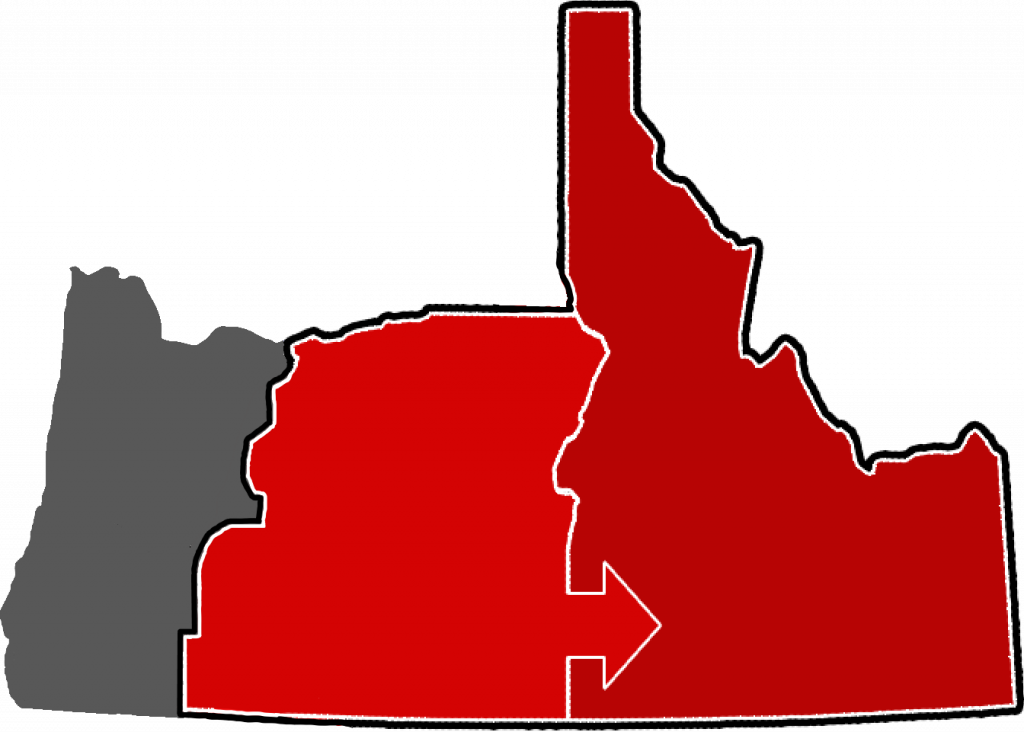
That is precisely why the Greater Idaho movement deserves to be taken seriously.
State Lines Are Not Sacred
Article IV, Section 3 of the United States Constitution explicitly provides a mechanism for altering the political geography of the Union. A new state may be formed within an existing state, or states may be joined or divided, with the consent of the state legislatures involved and the approval of Congress. The Constitution therefore does not treat the political map of the United States as permanently fixed. Rather, it establishes a deliberately demanding but peaceful process through which political boundaries can be reconsidered.
That provision is enormously important because it reveals something about the character of American federalism. The founders did not envision a nation in which the boundaries established at one point in history could never be reconsidered. At the same time, they did not give Congress unlimited authority to carve up states against their will. The constitutional arrangement requires consent.
In other words, American federalism contains a constitutional mechanism for political geography to change when political circumstances change.
Our nation’s history confirms this. Kentucky was separated from Virginia and admitted as a new state in 1792. Maine was separated from Massachusetts and admitted in 1820. These were not acts of rebellion against the Union. They were examples of the Union adapting its political geography as communities and circumstances changed.
The lesson is not that every county dissatisfied with its governor should immediately seek a new state. The lesson is more fundamental: political boundaries exist to serve self-government; they are not ends in themselves.
If those boundaries cease to serve that purpose, Americans have every right to ask whether they should be reconsidered.
Federalism: Designed for a Divided People
This is especially important in our present moment. America is deeply polarized. We disagree over abortion, the meaning of sex and gender, guns, taxation, education, environmental policy, criminal justice, land use, energy, immigration, and the proper size and role of government.
But the founders knew Americans would disagree. They did not create a political system requiring every community to reach consensus on every question. Instead, they divided governmental authority among local, state, and federal institutions precisely so that different communities could exercise control over their own affairs.
That is the genius of federalism. Americans can remain united without being politically identical.
The problem arises when political differences become so geographically concentrated that large portions of a state consistently find themselves governed by a political culture fundamentally different from their own. At that point, the issue is no longer whether one side can win the next election. The deeper question is whether the political boundaries themselves continue to correspond to the communities being governed.
And that’s where the Greater Idaho conversation becomes especially important.
Eastern Oregon is not Portland. Its economy is different. Its geography is different. Its communities are different. Its political priorities are different. A rancher in Malheur County and a resident of downtown Portland may both be Oregonians, but they have radically different ideas about what Oregon government should actually do.
That does not necessarily make one more authentically American than the other. It does, however, raise a legitimate question about self-government: Why should communities with dramatically different interests be permanently bound together by a political boundary established more than a century ago?
More pointedly, why is western Oregon so unwilling even to have that conversation?
That question deserves to be asked because the Greater Idaho movement is not some theoretical proposal originating from a handful of activists. Since 2020, thirteen eastern Oregon counties have approved measures supporting an examination of moving the Oregon-Idaho border. The measures are not themselves sufficient to change the boundary, but they demonstrate sustained local interest in opening the question.
At some point, the refusal to engage the question begins to raise its own questions.
If western Oregon genuinely believes that Greater Idaho is impractical, economically unsound, constitutionally unworkable, or undesirable for the people involved, then it should make that case. It should sit down with eastern Oregon officials, examine the proposal, debate the consequences, and demonstrate why the existing arrangement remains preferable.
But simply refusing to discuss the matter is harder to defend.
Why should communities be told that they are free to vote, but not free to ask whether the political structure governing them still makes sense?
Why should thirteen counties be able to repeatedly express their desire to explore the issue, only to have the state government refuse even to begin negotiations?
And why should a political establishment that routinely celebrates local control suddenly become suspicious of local control when rural communities use it to challenge the existing political arrangement?
Those questions expose the central tension.
The issue is not whether eastern Oregon has the legal authority to redraw the state line by itself. It does not. The issue is whether western Oregon is willing to acknowledge that self-government means allowing communities to raise uncomfortable questions about the government under which they live.
When One Oregon Consistently Governs Another
The political problem becomes clearer when we stop talking about Oregon as though it were a single, homogeneous political community.
It is not.
Oregon’s population and political power are heavily concentrated in the Willamette Valley and the Portland metropolitan region, while eastern and rural Oregon encompass enormous geographic territory with comparatively small populations. The result is predictable: the political priorities of the state’s population centers have enormous influence over policies governing communities hundreds of miles away.
That is not even a complaint about the legitimacy of elections (that’s a different conversation altogether). It’s simply a consequence of how representation works in a state whose population is heavily concentrated in particular geographic regions.
A majority can exercise its lawful political authority while still producing a political arrangement in which a substantial portion of the state is permanently unheard. Eastern Oregon can vote overwhelmingly for candidates and policies that are rejected by the population centers of western Oregon, and yet the overall political direction of the state remains largely unchanged.
The rural voter is not necessarily being disenfranchised in the technical sense. He is being outnumbered.
And when that happens election after election, decade after decade, the question eventually becomes larger than any individual policy: Is this still a workable political arrangement?
Consider the difference in priorities. Rural Oregonians depend heavily upon agriculture, ranching, timber, mining, energy production, hunting, and access to public lands. Their communities face different economic realities and different challenges involving transportation, public services, land management, housing, and employment. Yet many of the laws governing those communities are shaped by voters whose daily lives and economic circumstances can look dramatically different.
The conflict is not merely theoretical. In February 2026, for example, a bipartisan proposal to modestly expand rural housing opportunities was blocked in an Oregon Senate committee despite being developed with eastern Oregon county commissioners and planners and receiving support from the Association of Oregon Counties. Senator Todd Nash of Enterprise argued that rural communities should have greater authority to address their own housing needs rather than having decisions overridden by legislators from urban areas.
The particular bill is only one example, and reasonable people can disagree about its merits. But the larger pattern is difficult to ignore. Rural communities frequently confront problems that require policies tailored to rural conditions, while statewide political decisions are often driven by concerns originating in the state’s metropolitan centers.
Land-use policy provides another obvious example. Oregon’s statewide land-use system is built around 19 statewide planning goals that establish requirements for how cities and counties plan and regulate land. Local governments make many day-to-day land-use decisions, but their comprehensive plans and zoning regulations must conform to the statewide goals, and the state reviews those plans for compliance.
In rural areas, statewide policies governing urban growth boundaries, agricultural and forest lands, and rural development can substantially constrain what local communities may do with the land around them.
A policy that appears reasonable from a Portland neighborhood can have very different consequences for a rancher in Harney County. A regulation designed around the environmental and economic realities of the Willamette Valley can look very different when applied to the high desert. A statewide political culture that views firearms primarily through the lens of urban violence may struggle to understand why firearms occupy an entirely different place in rural communities. A legislature dominated by metropolitan interests may view public land primarily as an environmental resource, while rural communities may see that same land as intimately connected to livelihoods, timber, recreation, and local economies.
These are not merely partisan disagreements. They are differences of geography, economy, culture, and lived experience.
And when those differences become sufficiently large, redrawing political boundaries becomes a legitimate subject of public debate.
Greater Idaho is a Political Pressure Valve
This is where Greater Idaho offers something more interesting than other political arguments. It offers a potential pressure valve for a political system under increasing strain.
Instead of requiring eastern and western Oregon to endlessly fight over which side gets to impose its preferred political vision on the other, why not ask whether some of these conflicts could be reduced by creating political boundaries that better reflect the communities themselves?
The Greater Idaho proposal would not eliminate disagreement. It would not transform eastern Oregon into a political utopia, nor would it solve every dispute between urban and rural communities. But it could place a substantial number of decisions closer to the people who actually live with their consequences.
Eastern Oregon could govern according to the priorities of eastern Oregon.
Western Oregon could govern according to the priorities of western Oregon.
Neither side would have to win every political battle, and neither side would have to surrender its convictions. Most importantly, neither side would have to spend every legislative session attempting to control the other.
It’s not about making eastern Oregonians more powerful than western Oregonians. It’s about making them more responsible for governing themselves.
The Greater Idaho movement is attempting to align state governance more closely with the political preferences and values of the communities involved. Whether one supports that proposal or not, the underlying principle is worth considering: government works better when political authority corresponds more closely to the people and communities being governed.
Politics Can’t Fix a Broken Map
For decades, Americans have responded to polarization by fighting harder. We campaign harder, spend more money, demonize the other side more effectively, and fight over school boards, state legislatures, Congress, the courts, administrative agencies, and the presidency. Every election becomes existential. Every policy disagreement becomes a battle for the soul of the country.
Why?
Because when political differences are geographically concentrated, control of government becomes control over people who do not share your political vision or values.
If I live in a community where virtually everyone shares my political convictions, but a distant metropolitan center has the population necessary to determine the laws governing my community, political disagreements do not feel abstract. They feel imposed and tyrannical.
The same thing happens in reverse. Urban Americans can look at rural America and wonder why people living hundreds of miles away should have any political influence over their lives. Both sides become frustrated because both sides are trying to govern people who increasingly do not share their assumptions.
Americans have become more divided, but our political boundaries have not adapted to reflect that reality.
Perhaps our political boundaries have failed to keep pace with how divided—and how geographically sorted—we have become. Perhaps the way forward is looking back to Article IV, Section 3 of the United States Constitution.
That possibility deserves serious consideration.
A Better Kind of Political Peace
This is why Greater Idaho should not be dismissed as a fringe political fantasy.
Perhaps it will ultimately prove impractical. Perhaps negotiations will fail. Perhaps economic, legal, or administrative complications will make the proposal unworkable. Those are legitimate questions, and they deserve serious answers.
But those questions are arguments that support examining the proposal, not ridiculing it.
The constitutional process already exists. The political differences already exist. The geographic divisions already exist. And thirteen counties have already voted to ask that the question be explored. The question is whether western Oregon has the courage to consider whether our political map should reflect those realities.
Sometimes peace in a fallen world does not come from convincing everyone to agree. Sometimes peace comes from giving people enough room to disagree without constantly governing one another.
The Map is a Tool to Heal Political Division
We should think bigger than Oregon. The same phenomenon exists throughout America. Rural Washington has different priorities than Seattle. Downstate Illinois has different priorities than Chicago. Upstate New York has different priorities than New York City. Rural California has different priorities than Los Angeles and San Francisco.
The same pattern can be found across the country: urban political centers increasingly dominate states containing enormous rural populations whose political preferences are radically different from those of the metropolitan majority. For decades, we have responded by telling everyone to compromise. But maybe it’s time we should recover another American tradition: let people govern themselves.
We do not need every state to look politically identical. We do not need every community to adopt the same policies. We do not need every American to win every political argument. We need a system that allows Americans to live differently while remaining united in those limited and fundamental virtues that properly belong to the nation as a whole.
That is what federalism was designed to accomplish.
And if adjusting a state boundary can meaningfully reduce political conflict, increase local representation, and allow geographically coherent communities to govern themselves more effectively, then we should not be afraid of the idea. We should welcome the conversation.
America was not founded on the idea that we all agree. It’s that we found a way to remain one people without requiring uniformity.
Let Portland govern Portland. Let eastern Oregon govern eastern Oregon. Let Seattle govern Seattle. Let rural Washington govern rural Washington. Let Chicago govern Chicago. Let downstate Illinois govern downstate Illinois. Where political communities have become genuinely different, we should stop treating that difference as a problem that must be conquered and begin treating it as a reality that government should accommodate.
This would not solve every political disagreement in America. But it could solve something far more fundamental: the constant struggle to make people with different political visions live under political institutions designed around the preferences of the other side.
Maybe America does not need less federalism.
Maybe it needs more.
Conclusion
Greater Idaho will certainly not solve every problem in Oregon. But it could address something that politics has repeatedly failed to solve: the problem of forcing increasingly different communities to fight over the same government.
The answer to our political crisis is not another election. It’s not another Supreme Court decision or another thousand-page federal law. In some cases, the answer is simply a better line on the map.